

pcb production and assembly handle vibration and shock
Printed Circuit Board (PCB) production and assembly face significant challenges in handling vibration and shock, particularly in applications where electronic devices are subjected to harsh operating conditions such as automotive, aerospace, industrial, and military environments. Vibration and shock can lead to mechanical stress, component fatigue, solder joint failures, and PCB delamination, compromising the integrity and reliability of electronic assemblies. To address these challenges, PCB production and assembly employ various design techniques, materials, and manufacturing processes to ensure that PCBs can withstand vibration and shock while maintaining performance and reliability.
One of the primary strategies for mitigating the effects of vibration and shock is through proper PCB design. Design considerations such as component placement, trace routing, and mounting techniques play crucial roles in minimizing mechanical stress and enhancing structural integrity. Strategic component placement reduces the length of signal traces and minimizes the risk of signal degradation due to vibration-induced noise. Trace routing techniques such as differential pair routing and length matching help mitigate signal skew and ensure uniform signal propagation, even under vibrational loads.
Moreover, pcb production and assembly employ specialized mounting techniques to secure components and PCB assemblies to the chassis or enclosure of electronic devices. Techniques such as through-hole mounting, surface mounting, and conformal coating help ensure that components remain securely attached to the PCB substrate and resistant to mechanical displacement or damage caused by vibration and shock. Additionally, advanced mounting methods such as shock mounts, vibration dampening pads, and stiffeners provide further protection against mechanical stress and vibration-induced fatigue.
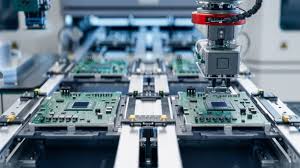
How do pcb production and assembly handle vibration and shock?
Furthermore, PCB production and assembly utilize materials with high mechanical strength, thermal stability, and dimensional stability to withstand vibration and shock. Substrate materials such as FR-4 epoxy resin and polyimide offer excellent mechanical properties, including high tensile strength, flexural strength, and impact resistance, making them well-suited for applications requiring durability and reliability under vibrational loads. Advanced laminate materials with reinforced fiberglass or ceramic fillers provide enhanced rigidity and dimensional stability, minimizing the risk of PCB warping or deformation due to mechanical stress.
Additionally, PCB production and assembly employ specialized manufacturing processes to enhance the durability and reliability of PCBs under vibrational and shock loads. Techniques such as controlled impedance manufacturing, multilayer stacking, and selective reinforcement help optimize PCB designs for mechanical robustness and structural integrity. Surface finish treatments such as immersion silver, immersion gold, and electroless nickel immersion gold (ENIG) provide corrosion resistance and solderability, ensuring long-term reliability in harsh environments.
In addition to design and materials considerations, PCB production and assembly conduct rigorous testing and inspection to validate the mechanical robustness and reliability of PCB assemblies under vibrational and shock loads. Environmental testing methods such as vibration testing, shock testing, and mechanical shock testing subject PCB assemblies to simulated operating conditions, including random vibration, sinusoidal vibration, and mechanical shock events. These tests help identify potential weaknesses, design flaws, or manufacturing defects that could compromise the integrity and reliability of PCB assemblies in real-world applications.
In conclusion, PCB production and assembly employ a combination of design techniques, materials, manufacturing processes, and testing methods to address the challenges of vibration and shock in electronic devices. By prioritizing mechanical robustness, structural integrity, and reliability, PCB manufacturers and assemblers ensure that PCBs can withstand the rigors of harsh operating environments while maintaining performance and functionality. As electronic devices continue to evolve and become increasingly pervasive in critical applications, the importance of robust PCB production and assembly practices in handling vibration and shock cannot be overstated.